ॐ
Fetching planetary data...
The Pooja Room is the spiritual powerhouse of your home. Aligning your sacred altar with the divine Northeast (Ishanya) corner fills the entire household with cosmic peace and protection.
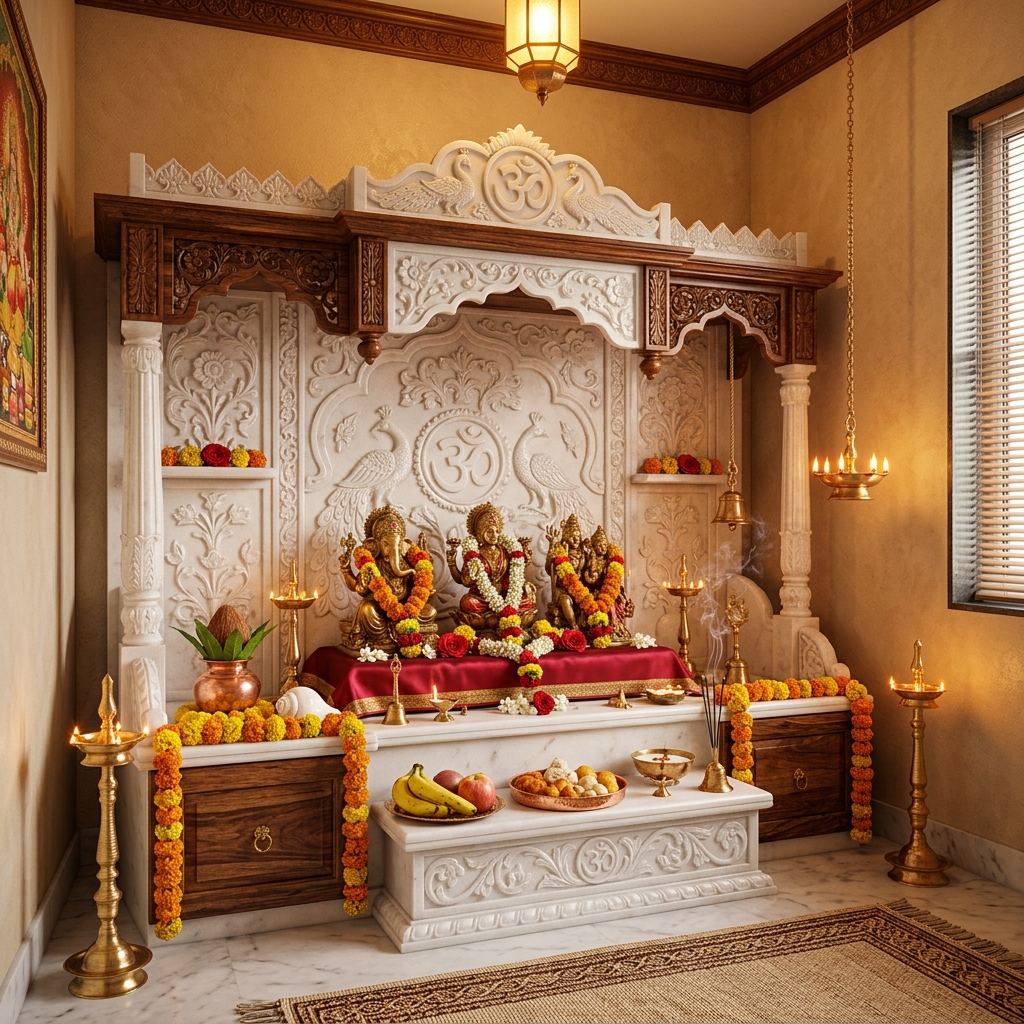
Proper idol orientation and natural materials magnify the acoustic and energetic potency of daily mantra chanting.
The Pooja room should be in the Northeast (Ishanya) corner of the home. Governed by Lord Shiva (Ishanya) and Jupiter, this corner receives the purest geomagnetic prana and morning UV-A solar radiation, maximizing spiritual receptivity.
Place deity idols so they face East or West. While praying, the devotee should face East (solar energy/wisdom) or North (Kubera/wealth). Idols should never touch the back wall directly — leave a 1-inch gap for energy circulation.
A wooden or marble Mandir with a pyramidal or dome roof (Gopuram structure) naturally concentrates cosmic vibrations. Teakwood, Sheesham, and white Makrana marble are the most sattvic materials.
Keep the oil diya, brass bell, and incense holder (Dhupa) in the Southeast corner of the Pooja altar. The lamp flame should face East or North.
Walking above sacred deities creates heavy negative energy pressure. Remedy: Shift Mandir to a clean wall cabinet.
Intimacy energy conflicts with pure prayer energy. Remedy: Use a wooden door/curtain to cover the Mandir when not in use.
Unsanitary elimination energy pollutes divine frequencies. Remedy: Maintain a 2-inch wooden gap between wall and Mandir.
You must build a large separate room for a Pooja room, otherwise Vastu is violated.
A small wall-mounted wooden Mandir placed neatly in the Northeast or East quadrant of your living room is 100% Vastu compliant.
Placing pictures of deceased ancestors inside the Pooja Mandir brings blessings.
Ancestors (Pitr) belong to the South/Southwest zone. Placing ancestor photos alongside deity idols in the Northeast causes elemental confusion. Keep ancestor photos on a South wall.
Metal or brass idols must be larger than 10 inches in a home Mandir.
Agamas recommend that home Mandir idols be between 2 to 7 inches tall for easy daily Prana consecration and cleaning.
The Northeast (Ishanya) corner of the house is the best direction for a Pooja room, followed by East and North.
Face East (for wisdom, memory, and spiritual growth) or North (for wealth and prosperity) while offering prayers.
Yes, provided the Mandir is in the Northeast corner of the kitchen and kept covered with a curtain when cooking non-sattvic food.
White, light yellow, saffron cream, or light sky blue. Avoid dark red, black, or dark grey.
Place the diya or brass lamp in the Southeast corner of the Mandir altar, with the flame pointing East or North.
No. Ancestor photos should be placed on a South or Southwest wall, separate from deity altars.