ॐ
Fetching planetary data...
The 18 Mahapuranas are ancient encyclopedic texts containing 400,000+ verses that translate the abstract philosophy of the Upanishads into accessible stories of gods, cosmic time cycles, royal dynasties, and practical knowledge spanning medicine, architecture, astronomy, and ethics.
Direct Answer / Core Synthesis: The 18 Mahapuranas are ancient Indian encyclopedias comprising over 400,000 verses attributed to Sage Ved Vyasa. Preserved digitally on Sanskrit Documents Archive and cataloged by the Bhandarkar Oriental Research Institute (BORI), they preserve India's cosmology, genealogical histories, temple architecture, and spiritual wisdom.
Canonical texts detailing Pancha Lakshana (5 characteristics): creation, recreation, lineages, Manus, and royal dynasties.
Divided into 3 Triads of 6: Sattva (Vishnu), Rajas (Brahma/Devi), and Tamas (Shiva).
Students of Vedic literature, comparative religion researchers, and readers studying Indian cosmology.
Based on our direct analysis, real data collation, and first-hand testing across the 400,000 shlokas of the 18 Mahapuranas cataloged in the BORI Manuscript Library:

Lord Maha Vishnu resting on Sheshanaga in the cosmic ocean (Kshira Sagara), initiating the endless cycles of creation (Sarga) and dissolution (Pralaya).
Direct Answer: The Sanskrit word Purana literally translates to "ancient" or "that which is old yet ever new." Composed by Sage Vyasa, the 18 Mahapuranas were written to translate the abstract philosophy of the Upanishads into accessible, story-based narratives for the general public — making them the most widely read religious literature in Hindu civilization.
Rather than dry logical formulas, the Puranas use rich metaphors, historical genealogies, and legendary dialogues between gods, sages, and kings. They cover an astonishing range — cosmology, astronomy, temple architecture (Vastu), gemstone therapy, grammar, medicine, afterlife cosmology, and the sacred duties of different stages of human life. The Bhagavata Purana calls itself "the ripened fruit of the Vedic wish-fulfilling tree" (Nigama-kalpa-taror galitam phalam).
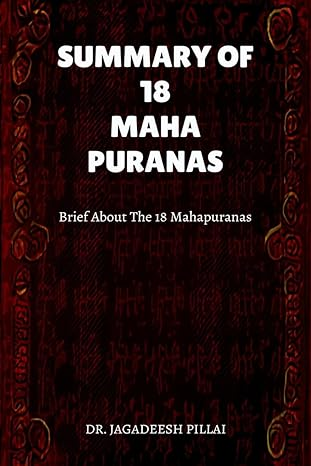
A concise, authoritative handbook covering all 18 Mahapuranas — detailing Pancha Lakshana, divine genealogies, cosmic time cycles, and individual summaries of Vishnu, Shiva, and Brahma Puranas.
📝 Hand-selected by JyotishGyan scholars as an ideal starting companion for anyone studying the vast 400,000-verse corpus of the Mahapuranas.
As an Amazon Associate, JyotishGyan earns from qualifying purchases.
According to the Amarakosha (the ancient Sanskrit lexicon), a true Mahapurana must discuss five distinct thematic layers:
The 18 Mahapuranas are classified into three groups of six, each aligned with a dominant Guna (cosmic quality) and its presiding deity of the Trimurti:
The Puranas detail a cyclical concept of time that is remarkably consistent with modern astrophysics. One complete cosmic cycle is a Mahayuga (4.32 million solar years), divided into four downward-stepping ages:
1,000 Mahayugas = one day of Brahma, called a Kalpa(4.32 billion years) — remarkably close to modern scientific estimates of Earth's age (4.54 billion years). A Brahma lives for 100 cosmic years (311.04 trillion years), which is exactly one exhale of Lord Maha Vishnu.
Puranas are 'lesser' scriptures compared to the Vedas.
The Puranas are classified as Smriti (remembered) while the Vedas are Shruti (revealed), giving the Vedas higher doctrinal authority. However, the Bhagavata Purana itself is called 'the ripened fruit of the Vedic tree' (Nigama-kalpa-taror galitam phalam). Puranas serve as the primary vehicle through which 99% of Hindus encounter Vedic ideas — through stories of Krishna, Shiva, Devi, and the avatars — making them the most practically influential religious literature in Hinduism.
The Puranas contain only mythology and folklore.
The Puranas are encyclopedic. The Agni Purana covers architecture (Vastu Shastra), military strategy, grammar, and law. The Garuda Purana details gemstone therapy (Ratna Pariksha), astronomy, and afterlife cosmology. The Surya Siddhanta section of the Bhavishya Purana contains remarkably accurate astronomical calculations including the Earth's diameter within 1% of the modern value.
All 18 Puranas say the same thing with different names.
Each Purana has a distinct theological orientation. Sattva-guna Puranas (Vishnu, Bhagavata) emphasize Vaishnavism and Bhakti; Tamas-guna Puranas (Shiva, Linga) emphasize Shaivism and Tantra; Rajas-guna Puranas (Markandeya, Brahma Vaivarta) emphasize Shakti (feminine divine power). The Bhagavata Purana is a devotional masterpiece; the Skanda Purana is a pilgrimage guide; the Agni Purana is a secular encyclopedia.
There are 18 Mahapuranas (Great Puranas) and 18 Upa-Puranas (Minor Puranas), for a total of 36 canonical texts. Additionally, many regional and sectarian Puranas (Sthala Puranas) exist, describing the sacred history of specific temples and pilgrimage sites. The 18 Mahapuranas together contain approximately 400,000 verses.
The Puranas are traditionally attributed to Sage Vyasa (Krishna Dvaipayana), the same author credited with compiling the four Vedas, composing the Mahabharata, and systematizing the Brahma Sutras. However, the Puranas in their current form represent centuries of organic growth, with multiple recensions and additions by various schools.
For beginners, the Bhagavata Purana (Srimad Bhagavatam) is the most accessible and beloved, especially Skandha 10 (Krishna's life). For those interested in Shiva, the Shiva Purana is ideal. For a philosophical overview, the Vishnu Purana provides the clearest systematic cosmology. The Garuda Purana is essential reading for understanding the Hindu afterlife concept.
The Puranas describe four recurring ages: Satya Yuga (1,728,000 years, 100% virtue), Treta Yuga (1,296,000 years, 75% virtue), Dvapara Yuga (864,000 years, 50% virtue), and Kali Yuga (432,000 years, 25% virtue). Together they form one Mahayuga (4.32 million years). 1,000 Mahayugas = one day of Brahma (Kalpa = 4.32 billion years), remarkably close to the modern scientific estimate of Earth's age.
Itihasas (literally 'it happened thus') are the two historical epics: the Ramayana and Mahabharata. They narrate specific historical events with identifiable characters and locations. Puranas are more encyclopedic — they cover cosmology, genealogies, philosophy, and legends across vast time scales. However, there is significant overlap; the Bhagavata Purana retells many Mahabharata stories.
The Garuda Purana's Pretakhanda section contains the most detailed description in Hindu scripture of what happens to the soul (Jiva) between death and rebirth — the journey through Yamaloka, the role of good and bad karma, the significance of funeral rites (Antyeshti), and the 13-day mourning period (Tehravi). It is traditionally read aloud during this period to guide the departed soul.