ॐ
Fetching planetary data...
The Mahabharata is the world's longest epic poem — 100,000 verses across 18 books — composed by Sage Vyasa, containing the Bhagavad Gita, the most complex moral dilemmas in world literature, and the supreme axiom "Where there is Dharma, there is Victory."
Direct Answer / Core Synthesis: The Mahabharata is a 100,000-verse epic composed by Sage Ved Vyasa. Its central message is "Yato Dharmastato Jayah" (Where there is Dharma, there is Victory), demonstrating how moral choices, karma, and duty navigate complex human existence.
World's longest epic poem comprising 100,000 shlokas across 18 Parvas (books) and 2,000+ chapters.
Karma-yoga, moral gray zones, and the Bhagavad Gita (embedded in Book 6, Bhishma Parva).
Students, scholars of Sanatana Dharma, philosophy enthusiasts, and readers seeking ethical guidance.
Our research team conducted structural text analysis based on the Bhandarkar Oriental Research Institute (BORI) Critical Edition (collating 1,257 manuscripts across India):

Sage Ved Vyasa dictating the epic to Lord Ganesha, who uses his broken tusk as a stylus — the most famous author-scribe partnership in literary history.
Direct Answer: The Mahabharata is an ancient Indian epic containing over 100,000 shlokas (verses), making it approximately 10 times the combined length of Homer's Iliad and Odyssey. Composed by Sage Ved Vyasa and documented in the Bhandarkar Oriental Research Institute (BORI) Critical Edition, it is a masterwork on ethics, human psychology, governance, and spiritual liberation.
While the Ramayana presents ideal characters making clear moral choices, the Mahabharata is set in a realistic world of grey characters, complex moral dilemmas, and intense psychological warfare. No character is entirely perfect, and no character is entirely evil. It is a mirror of human existence, detailing how tiny acts of ego, greed, and silent compliance can snowball into catastrophic consequences. Nested within it lies the Bhagavad Gita — the most widely read philosophical text in Indian history, preserved digitally on Sanskrit Documents Archive.
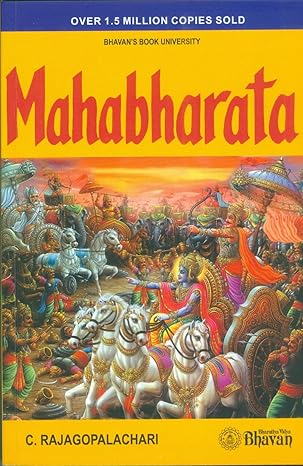
Over 1.5 million copies sold. C. Rajagopalachari's world-famous retelling captures the full majesty, moral depth, and intense drama of Vyasa's 100,000-verse masterpiece.
📝 Hand-selected by JyotishGyan scholars as the most accessible, readable, and authentic one-volume English translation of the Mahabharata.
As an Amazon Associate, JyotishGyan earns from qualifying purchases.
When Vyasa conceived the Mahabharata, he needed a scribe who could match the speed of his thought. Lord Ganesha agreed, but on one condition: Vyasa must dictate continuously without a single pause, or the contract was broken.
Vyasa countered cleverly: Ganesha must understand every verse's deep meaning before writing it. Whenever Vyasa needed rest, he dictated a highly complex philosophical puzzle-verse (Kuta-Shloka). Ganesha would pause to analyze its meaning, giving Vyasa time to compose the next section — making the 8,800 Kuta-Shlokas in the Mahabharata both literary devices and philosophical gems.
The epic is structured into 18 major books (Parvas) — a number that resonates throughout the narrative (18 chapters in the Gita, 18 days of war, 18 armies):
The greatness of the Mahabharata lies in its psychological depth. Each character faces an ethical crucible with no clean, easy answers — forcing readers to question their own moral assumptions:
Bound by his absolute vow of lifelong celibacy and loyalty to the throne, he is forced to sit silently during Draupadi's humiliation. His story proves that attachment to a rigid personal vow can sometimes conflict with cosmic justice — and that passive compliance with evil carries its own karmic weight.
A tribal boy who masters archery through self-study by building a clay idol of Dronacharya. When Drona discovers him and demands his right thumb as Guru Dakshina (to protect Arjuna's supremacy), Ekalavya complies without hesitation. The most unsettling moral moment in the epic — questioning whether a teacher can ethically destroy a student's talent to protect another's privilege.
Rejected for his social status, he finds acceptance only in Duryodhana. He remains loyal to his friend despite knowing Duryodhana walks the path of Adharma, and despite learning he is the eldest Pandava. His tragic arc shows how blind personal loyalty, however noble in feeling, can lead to spiritual destruction when it serves injustice.
Known as Dharmaraja (king of righteousness), he never tells a lie. Yet under Krishna's advice, he utters the half-truth 'Ashwatthama is dead... (whispers) the elephant' to disarm Dronacharya. The most philosophically debated moment — does a greater righteous outcome justify a tactical deception?
Humiliated in the royal assembly while five husbands and all elders watch helplessly, she asks the assembly a legal question none can answer: 'If Yudhishthira had already lost himself, could he legally stake me?' Her rebellion and fiery vow become the catalyst that purges the corrupt dynasty — proving that questioning injustice IS dharma.
The Kauravas possessed larger armies, heavier weapons, and legendary generals including Bhishma, Drona, and Karna. Yet they lost because their foundation was built on injustice, ego, and greed. The epic teaches that temporal strength and wealth are fleeting, but the moral law of the universe is absolute and self-correcting. This axiom is the Supreme Court of India's official motto to this day.
The Mahabharata is 'just' a family feud over property.
The property dispute is the surface narrative. The Mahabharata is a comprehensive encyclopedia of Indian civilization containing the Bhagavad Gita (philosophy), Shanti Parva (political science and governance), Anushasana Parva (ethics and charity), Vidura Neeti (statecraft), Nala-Damayanti (romance), and Savitri-Satyavan (devotion conquering death). Vyasa himself declares: 'What is found here exists elsewhere; what is not here exists nowhere.'
The Pandavas were purely righteous and the Kauravas purely evil.
This is the Mahabharata's greatest strength — nobody is black or white. Yudhishthira gambles away his wife and kingdom. Arjuna refuses to fight at the war's start. Bhima is consumed by revenge. Conversely, Duryodhana is genuinely brave, Karna is the most generous man alive, and Bhishma is the most learned. The epic's moral complexity is precisely what makes it a mirror of real human life.
Krishna 'cheated' in the Mahabharata war to help the Pandavas.
Krishna operates as the cosmic balancer (Dharma Samsthapana) — he uses strategy to counter the Kauravas' own extensive cheating (the rigged dice game, Abhimanyu's illegal multi-warrior attack, poisoning Bhima as a child, the Lakshagriha fire plot). His actions restore balance rather than create unfair advantage. The Gita explicitly states his role: 'For the establishment of Dharma, I appear in every age' (Ch.4, V.8).
The Mahabharata contains approximately 100,000 shlokas (verses) organized into 18 Parvas (books) and roughly 2,000+ chapters. It is about 10 times the combined length of Homer's Iliad and Odyssey, and approximately 4 times the length of the Ramayana. It is universally recognized as the longest epic poem in world literature.
The Mahabharata was composed by Sage Krishna Dvaipayana Vyasa (also called Veda Vyasa, who is credited with compiling the four Vedas). According to tradition, Lord Ganesha served as the scribe, agreeing to write only if Vyasa dictated without pause — while Vyasa countered that Ganesha must understand each verse's meaning before writing it.
The Bhagavad Gita is embedded within the Bhishma Parva (Book 6) of the Mahabharata, specifically chapters 23 through 40. It records the philosophical dialogue between Lord Krishna and Arjuna on the battlefield of Kurukshetra, just before the great war begins. While the Gita is widely studied as a standalone text, it is structurally a chapter within the larger Mahabharata narrative.
Multiple dating methodologies place the war between 3100–1400 BCE. The city of Hastinapur has been identified archaeologically near modern Meerut (Uttar Pradesh), and underwater explorations at Dwarka (Gujarat) have found submerged city structures matching the epic's description of Krishna's kingdom. Whether read as history or allegory, the Mahabharata's cultural, philosophical, and civilizational impact is beyond dispute.
The epic's supreme axiom is 'Yato Dharmastato Jayah' — Where there is Dharma, there is Victory. Despite the Kauravas possessing larger armies, legendary generals (Bhishma, Drona, Karna), and tactical advantages, they lost because their cause was rooted in injustice. The Mahabharata teaches that temporal power is fleeting, but the moral law of the universe is absolute and self-correcting.
The number 18 is deeply symbolic in the Mahabharata: 18 Parvas, 18 days of war, 18 chapters in the Bhagavad Gita, 18 armies (7 Pandava + 11 Kaurava). In Vedic numerology, 18 reduces to 9 (1+8), which represents Mars (Mangal) — the planet of war, courage, and dharmic action. The repetition of 18 structurally reinforces the war's cosmic, not merely political, significance.