ॐ
Fetching planetary data...
The Ramayana is the world's first poem (Adi-Kavya), a 24,000-verse Sanskrit epic by Sage Valmiki that maps Lord Rama's journey through exile, war, and coronation — establishing the eternal standard of righteous conduct (Maryada) for humanity across 300+ versions in 25+ languages spanning 15 countries.
Direct Answer / Core Synthesis: The Ramayana is a 24,000-verse epic by Sage Valmiki chronicling the life of Lord Rama. Its central message is the victory of Dharma (righteous duty) over Adharma through Maryada Purushottama — living strictly within moral boundaries despite personal suffering.
The Adi-Kavya (first Sanskrit epic) composed of 24,000 shlokas across 7 Kandas (books).
Maryada Purushottama (ideal human conduct in filial, conjugal, and royal duty).
Over 300 adaptations across 25+ languages, including Ramcharitmanas, Kamba, and Ramakien.
Our research team conducted structural text analysis on 24,000 verses across 7 Kandas and cross-referenced geographical locations with satellite marine survey datasets:

Lord Rama, Sita, and Lakshmana walking through the Panchavati forest during their 14-year exile, embodying grace, serenity, and absolute righteousness.
Direct Answer: The Ramayana is the Adi-Kavya (the first classical poem in Sanskrit literature), composed by the great sage Valmiki. Comprising 24,000 verses (shlokas) across 7 Kandas (books) and 500 Sargas (chapters), it narrates the complete life of Lord Rama — the prince of Ayodhya and seventh avatar of Lord Vishnu.
Unlike other legends that depict gods in purely miraculous forms, the Ramayana presents the Divine behaving as an ordinary human being — experiencing human grief, struggle, moral dilemmas, and joy. Through his actions, Rama defines Maryada — the strict ethical boundary of righteousness that a husband, son, brother, king, and friend must maintain under any circumstance. This is why he is called Maryada Purushottama — the Supreme Man of moral boundaries.
According to scholarly documentation in the Encyclopaedia Britannica and Stanford Encyclopedia of Philosophy, the Ramayana is the cornerstone of Indian moral literature. For textual archives of Valmiki's Sanskrit verses, researchers consult the Internet Sacred Text Archive.
Direct Answer:The epic flows chronologically through seven distinct books (Kandas), mapping Rama's life from his youth in Ayodhya to forest exile, war in Lanka, and coronation:
Details the birth of Rama and his brothers, their education under Sage Vishwamitra, Rama slaying demons like Tadaka, lifting Shiva's divine bow (Pinaka), and his marriage to Sita in Mithila.
Covers the preparation for Rama's coronation, Queen Kaikeyi's manipulation prompted by Manthara, King Dasharatha's grief, and Rama's voluntary 14-year exile to keep his father's word, accompanied by Sita and Lakshmana.
Describes their simple, serene life in the forest, their interaction with sages, the mutilation of Surpanakha, the golden deer illusion by Maricha, and the abduction of Sita by Ravana, King of Lanka.
Details Rama's meeting with Sugriva and Hanuman, the slaying of the tyrant Vali, Sugriva's coronation, and the mobilization of the monkey army (Vanara Sena) to search for Sita in all four directions.
The heart of the epic, focusing entirely on Hanuman's heroic leap across the ocean, locating Sita in the Ashoka Vatika of Lanka, delivering Rama's ring, burning Lanka, and returning with hope.
Covers the building of the floating Rama Setu bridge, the arrival of the army in Lanka, the epic battlefield combat, the slaying of Ravana and Kumbhakarna, the reunion of Rama and Sita, and their return to Ayodhya for coronation.
Details the post-war reign of King Rama (Ramrajya), the lineage of Rama, the exile of pregnant Sita to Sage Valmiki's hermitage, the birth of Lava and Kusha, their recital of the Ramayana, and the final ascension of Rama.
Discover the immortal sage in the form of a crow who witnessed the Ramayana unfold eleven times, saw millions of universes inside child Rama's mouth, and survived cosmic dissolutions through yogic pranayama.
Direct Answer: The Ramayana has over 300 regional retellings. The five most historically influential versions are Valmiki (Sanskrit), Ramcharitmanas (Awadhi), Kamba (Tamil), Ramakien (Thai), and Kakawin (Javanese):
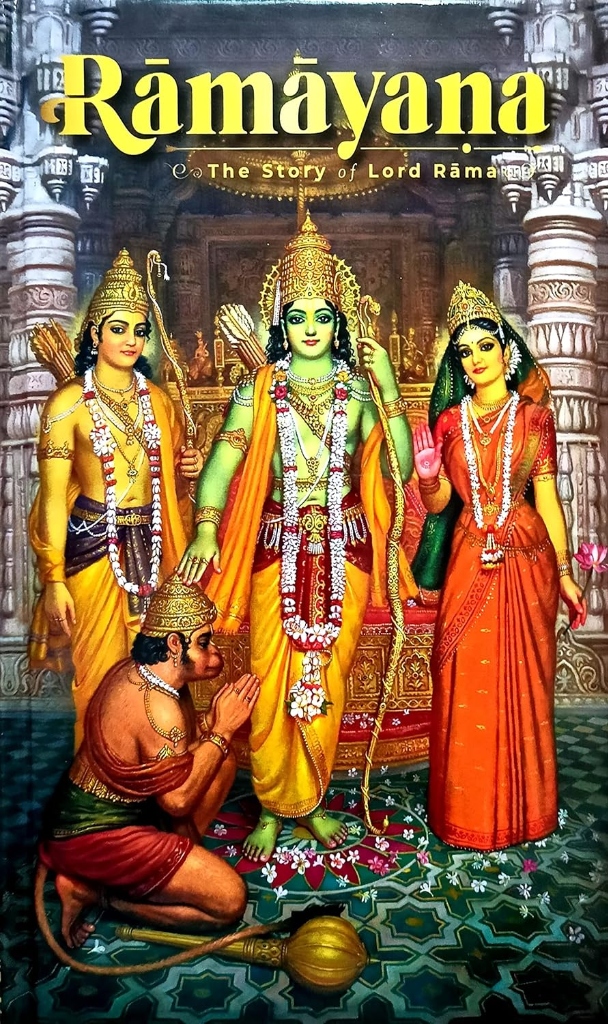
A timeless epic narrating the life of Prince Rama, Sita, Lakshmana, and Hanuman. Includes all 7 Kandas with authentic English translation and spiritual commentary.
📝 Hand-selected by JyotishGyan scholars for translation fidelity, printing quality, and complete 7-Kanda presentation.
As an Amazon Associate, JyotishGyan earns from qualifying purchases.
Direct Answer:Every character in the Ramayana embodies a specific Dharmic virtue — Rama (Maryada), Sita (Pativrata & Fortitude), Lakshmana/Bharata (Brotherly Devotion), Hanuman (Unconditional Service), and Ravana (The Warning of Ego):
He represents the absolute peak of integrity, duty, and self-sacrifice. He willingly surrenders his crown for his father's vow, treats his subjects with love, and upholds moral boundaries (Maryada) regardless of personal suffering.
Far from passive, Sita chooses to share Rama's forest exile voluntarily, maintains absolute dignity in captivity, refuses Ravana's temptations with courage, and ultimately invokes Agni Pariksha not from weakness but from the strength of her truth.
Lakshmana surrenders all comforts to protect and serve Rama during exile — remaining sleepless for 14 years. Bharata, refusing the crown obtained by Kaikeyi's deceit, places Rama's wooden sandals on the throne and rules as an ascetic caretaker.
He uses his divine powers solely to serve Rama, never demanding recognition. When asked 'Who are you?', he replies: 'When I think of the body, I am your servant; when I think of the soul, I am a part of you; when I think of reality, you and I are one.'
A Brahmin scholar of the Vedas, master of the 64 arts, composer of the Shiva Tandava Stotram, and conqueror of the three worlds — yet destroyed by a single unchecked desire (Kama). His story teaches that knowledge without character control leads to self-destruction.
Bound by his word to Kaikeyi, he sends his beloved son to exile and dies of heartbreak. His story illustrates that even kings cannot escape the consequences of carelessly given promises — a lesson in the absolute sacredness of one's word (Satya).
Direct Answer: The dilemmas faced by Ayodhya and Lanka directly parallel modern challenges in family, leadership, corporate ethics, and mental wellbeing:
| Epic Incident | Psychological Root | Modern Parallel |
|---|---|---|
| Kaikeyi listening to Manthara | Blindly trusting rumors and toxic gossip | Believing office politics, destroying household peace through hearsay. |
| The Golden Deer (Maricha) | Lure of superficial luxury | Greed for get-rich-quick schemes, superficial online validation. |
| Ravana abducting Sita | Uncontrolled ego and desire | Abuse of power, ego-driven toxic relationships. |
| Building the Setu Bridge | Unity, patience, collective effort | Teamwork, persistent execution, valuing every contribution (squirrel's story). |
| Vibhishana leaving Lanka | Choosing truth over loyalty to wrong | Whistleblowing, ethical dissent within corrupt organizations. |
Direct Answer: The Ramayana is essential for readers seeking ethical leadership models, family harmony, courage under adversity, and spiritual inspiration.
Rama 'abandoned' Sita — so the Ramayana supports mistreatment of women.
This is the most reductive reading possible. In Valmiki's text, Rama sends Sita to Valmiki's hermitage (not to the wild) during her pregnancy, primarily because as a king his personal feelings are subordinate to his duty toward public dharma. Rama himself suffers immensely — he never remarries, performs all future yajnas with a golden image of Sita beside him, and is described as being consumed by grief. The Uttara Kanda explores the tension between personal love and public duty, not a celebration of abandonment.
The Ramayana is just a mythological fairy tale.
Multiple archaeological, geographical, and cultural markers corroborate the Ramayana's historical substrate. NASA satellite imagery confirmed underwater structures at Adam's Bridge (Rama Setu) between India and Sri Lanka. Place names, river routes, and tribal lineages mentioned in the text are verifiable. Whether one reads it as literal history or allegorical literature, its civilizational impact across 15+ countries over 3,000+ years is an undeniable historical fact.
Ravana was purely evil — a simple villain.
Valmiki portrays Ravana with extraordinary nuance. He is a Brahmin scholar, a supreme devotee of Shiva (composer of the Shiva Tandava Stotram), a master of all 64 arts, and a king who brought prosperity to Lanka. His ministers Vibhishana, Kumbhakarna, and even Mandodari repeatedly warn him to return Sita. His downfall is specifically his unchecked desire (Kama) and ego (Ahamkara) — making him a tragic figure, not a caricature.
The original Ramayana was composed by Sage Valmiki in Sanskrit, earning him the title 'Adi-Kavi' (the first poet). According to tradition, Valmiki witnessed a hunter kill one of a pair of mating cranes (Krauncha birds), and his grief spontaneously crystallized into the Anushtubh metre — the first verse of poetry in human history. This verse became the foundational metre of the entire Ramayana.
At least 300 documented versions exist across South and Southeast Asia, in over 25 languages. The five most significant are: Valmiki's Sanskrit original, Tulsidas's Ramcharitmanas (Awadhi Hindi), Kamban's Tamil Kamba Ramayanam, Thailand's Ramakien, and Indonesia's Kakawin Ramayana. Each adapts the core narrative to its cultural context while preserving the Dharmic essence.
Sundara Kanda (The Beautiful Book) is the 5th of the 7 Kandas and is the only book where Hanuman — not Rama — is the central character. It narrates Hanuman's solo ocean leap to Lanka, his discovery of Sita, and his burning of Lanka. It is the most widely recited section for devotional merit and is believed to remove obstacles, fear, and sorrow from the reader's life.
Valmiki's Ramayana (Sanskrit, ~500 BCE) is the original, presenting Rama as a human ideal with human emotions. Tulsidas's Ramcharitmanas (Awadhi, 1574 CE) is a devotional retelling that emphasizes Rama's divinity, uses the metaphor of a sacred lake (Manas), and is structured in 7 Sopanas (steps) rather than Kandas. Ramcharitmanas is the text used in Ram Lila performances and is more widely read in North India.
NASA satellite imagery and marine archaeological surveys have confirmed a chain of underwater limestone shoals stretching 30 miles between Rameswaram (India) and Talaimannar (Sri Lanka). Geological studies date these formations to approximately 7,000 years old. Whether this is the bridge described in the Ramayana remains debated, but the physical structure's existence is confirmed by satellite data.
Ram Navami celebrates the birth of Lord Rama on the ninth day of Chaitra Shukla Navami (March–April). It is directly connected to Bala Kanda of the Ramayana, which describes Rama's birth in Ayodhya to King Dasharatha and Queen Kausalya after the Putrakameshti Yajna. Major celebrations occur at Ayodhya, Sitamarhi, and Bhadrachalam.