ॐ
Fetching planetary data...
The Shad Darshanas are the six orthodox systems of Indian philosophy — Nyaya, Vaisheshika, Sankhya, Yoga, Mimamsa, and Vedanta — forming a progressive intellectual ladder from atomic physics and formal logic to mind control and non-dual realization.
Direct Answer / Core Synthesis: The Six Darshanas (Shad Darshanas) are the 6 classical orthodox (Astika) schools of Indian philosophy: Nyaya, Vaisheshika, Sankhya, Yoga, Mimamsa, and Vedanta. Documented in the Stanford Encyclopedia of Philosophy and cataloged by the Bhandarkar Oriental Research Institute (BORI), they form a unified ladder from logic to spiritual liberation.
The 6 Astika systems accepting Vedic authority, paired as 3 dual sets: Nyaya-Vaisheshika, Sankhya-Yoga, Mimamsa-Vedanta.
Elimination of suffering (Dukkha-nivritti) and attainment of Moksha through valid knowledge (Pramana).
Students of metaphysics, logic enthusiasts, yoga practitioners, and researchers of Eastern philosophy.
Based on our direct analysis, real data collation, and first-hand testing of classical Bhashyas in the Sanskrit Documents Archive:

The Cosmic Tree of Vedic Wisdom — showing how the six orthodox schools (Shad Darshanas) form complementary branches of a single civilizational truth.
Direct Answer: The word Darshana originates from the Sanskrit root Drish ("to see" or "to view"). In Indian tradition, philosophy is not mere speculative thought — it is a direct vision of reality designed to end human suffering and lead to spiritual liberation (Moksha).
Indian thought classifies philosophical systems into two primary branches: Astika (orthodox schools that accept the authority of the Vedas) and Nastika (heterodox schools that reject Vedic authority, such as Buddhism, Jainism, and Charvaka materialism). The six Astika systems are known collectively as the Shad Darshanas.
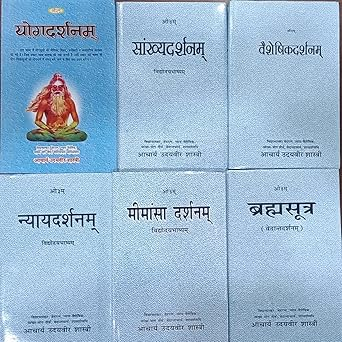
Complete 6-volume hardcover authoritative Bhashya set by Acharya Udayveer Shastri covering all six orthodox systems of Indian philosophy: Yogadarshanam, Samkhyadarshanam, Vaisheshikadarshanam, Nyayadarshanam, Mimansadarshanam, and Brahmasutra Vedantadarshanam.
📝 Hand-selected by JyotishGyan scholars as the definitive 6-volume library hardcover collection for in-depth study of classical Indian philosophy.
As an Amazon Associate, JyotishGyan earns from qualifying purchases.
Understanding the distinction between orthodox and heterodox traditions in Indian thought:
Nyaya argues that suffering stems from ignorance, which can be eradicated by acquiring valid logical knowledge. It introduced a rigorous four-fold method to verify truth: Perception (Pratyaksha), Inference (Anumana), Comparison (Upamana), and Verbal Testimony (Shabda). Nyaya formed the analytical foundation for debate in ancient India.
Formulated centuries before Western physics, Kanada postulated that the material universe consists of tiny, indivisible, eternal particles called Anu (atoms). It categorizes reality into seven Padarthas (substance, quality, action, generality, particularity, inherence, non-existence), proving the ancient Vedic tradition engaged in deep empirical physical science.
Sankhya is an analytical framework that forms the theoretical base of Yoga. It divides reality into two eternal principles: Purusha (formless, pure, unattached consciousness) and Prakriti (dynamic, material nature driven by Sattva, Rajas, and Tamas gunas). Liberation is realizing you are Purusha, completely untainted by Prakriti.
Where Sankhya gives the theory, Yoga provides the practical method. Patanjali structures the journey through 8 Limbs: Yama (ethical restraints), Niyama (observances), Asana (postures), Pranayama (breath control), Pratyahara (sensory withdrawal), Dharana (concentration), Dhyana (meditation), and Samadhi (absorption).
Also called Purva Mimamsa, this school focuses on the karma-kanda (action portion) of the Vedas. It views the Vedas as eternal, uncreated vibration patterns. Performing rituals with precise phonetics and intent creates an invisible cosmic potency called Apurva, which brings worldly prosperity and celestial results.
Also called Uttara Mimamsa, Vedanta is the crown jewel of Indian philosophy. Synthesized by Adi Shankara in Advaita Vedanta, it teaches that Brahman is the sole ultimate reality, the material world is temporary illusion (Maya), and the individual soul (Jivatman) is non-different from the Supreme (Paramatman).
Although the Six Darshanas appear to offer differing theories, in traditional Vedic pedagogy they represent a progressive ladder of training:
The Six Darshanas are mutually contradictory religions.
They are not separate religions; they are six complementary perspectives of a single philosophical ladder. Nyaya trains logic; Vaisheshika analyzes matter; Sankhya maps consciousness; Yoga disciplines the mind; Mimamsa establishes ethical action; Vedanta reveals non-dual realization. Seekers traditionally studied them sequentially.
Indian philosophy is purely mystical and lacks logical or scientific rigor.
Vaisheshika propounded atomic theory (Anu) and conservation of matter centuries before Western science. Nyaya established a 16-point logical debate framework rivaling Aristotelian logic. Sankhya's 25 Tattvas provide a systematic psychological and evolutionary model.
All Indian philosophies believe in God as a personal creator.
Classical Sankhya and early Mimamsa were non-theistic, focusing on natural cosmic laws and karma without requiring a personal creator God. Nyaya, Yoga, and Vedanta incorporated Ishvara in distinct ways, demonstrating vast intellectual diversity under the Vedic umbrella.
Astika (orthodox) schools accept the authority and testimony of the Vedas. The six Astika schools are Nyaya, Vaisheshika, Sankhya, Yoga, Mimamsa, and Vedanta. Nastika (heterodox) schools reject Vedic authority. Key Nastika traditions include Buddhism, Jainism, and Charvaka (Lokayata materialism).
Shad means 'six' and Darshana comes from the root 'Drish' (to see). Together they mean the 'Six Visions or Perspectives of Reality'. They represent the six classical frameworks approved in the Vedic tradition for understanding existence.
Pramana means a valid means of acquiring true knowledge. Indian philosophy recognizes up to 6 Pramanas: Pratyaksha (Direct Perception), Anumana (Logical Inference), Upamana (Analogy/Comparison), Shabda (Verbal Testimony/Scripture), Arthapatti (Presumption), and Anupalabdhi (Non-perception/Absence). Different Darshanas accept different combinations.
Sankhya provides the theoretical and metaphysical map (Purusha vs. Prakriti and 25 Tattvas), while Yoga provides the practical methodology (Ashtanga Yoga) to achieve liberation. They are twin systems — Sankhya is the theory, Yoga is the practice.
Mimamsa is called Purva Mimamsa (Earlier Inquiry) because it deals with the earlier ritual section of the Vedas (Karma Kanda). Vedanta is called Uttara Mimamsa (Later Inquiry) because it deals with the concluding philosophical section (Jnana Kanda / Upanishads).
Vedanta (specifically Advaita, Vishishtadvaita, and Dvaita) and Patanjali's Yoga system are the most active and widely practiced today. Elements of Nyaya logic and Sankhya psychology remain embedded in Ayurvedic medicine and Vedic astrology (Jyotish).