1. Key Takeaways & Quick Summary
Bottom-Line Answer: Yama (Lord of Death and Dharma) and Yami (Goddess Yamuna) are primordial divine twins born to Surya and Sanjna. First recorded in Rigveda 10.10, their eternal bond established Bhai Dooj (Yama Dwitiya) on Kartika Shukla Dwitiya — a sacred festival granting protection from untimely death (Apamrityu) to brothers receiving their sister's tilak.
Target Audience & Use Case: Written for Bhai Dooj devotees, students of Vedic mythology, astrology practitioners, and readers seeking authentic scriptural origins from the Rigveda, Mahabharata, and Puranas.
- Vedic Origins: Yama is the first mortal to die and pioneer of Pitrloka; Yami is his twin sister who embodies life-sustaining waters.
- Rigveda 10.10 Dialogue: Yama rejects Yami's proposal for incestuous union based on cosmic Dharma, establishing ancient India's earliest moral law.
- Bhai Dooj Blessing: Yama's visit to Yami's house on Kartika Shukla Dwitiya created the tradition of sisterly tilak for longevity and protection.
Yama (Yamraj) is the Hindu god of death, dharma (cosmic order), and the afterlife, who judges souls according to their karma; Yami is his twin sister, who in later tradition becomes identified with the sacred river goddess Yamuna. Together they form one of the most ancient divine pairs in Hindu mythology, first appearing in the Rigveda as the primordial twins born to the solar deity Vivasvan (Surya) and his wife Sanjna (Conscience).
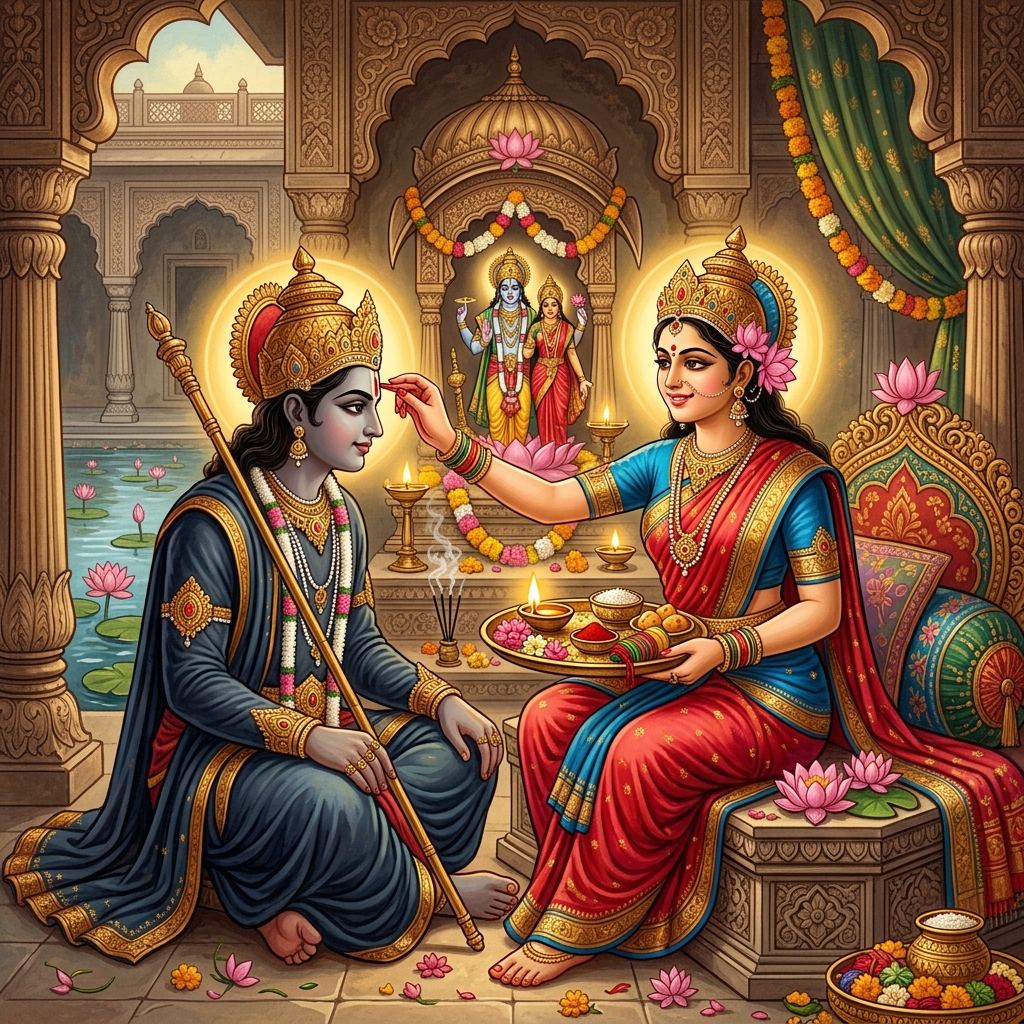
Their sacred sibling relationship gave birth to one of Hinduism's most cherished annual festivals: Bhai Dooj (also known as Bhaiya Dooj, Yama Dwitiya, or Bhaubeej). Celebrated two days after Diwali, Bhai Dooj honors the eternal bond of protection, love, and spiritual immunity between brothers and sisters — a living ritual reenactment of Yama's historic visit to his twin sister Yami's abode.
2. Who Are Yama and Yami in Vedic Origins?
Direct Answer: In the earliest Rigvedic hymns, Yama is a benign deity who acts as the first mortal to die, discovering the path to the celestial realm (Pitrloka) for all subsequent human souls. Yami is his primordial twin sister who embodies life-giving generative power.
The figure of Yama is among the oldest in the Hindu pantheon. In the earliest Ṛgvedic hymns he is a benign god who looks after the well-being of the dead, entertaining them with food and shelter in a pleasant heavenly realm; survivors supplicate him for the care of their departed relatives.
The Vedas describe him as the first mortal to die — by dying first, he discovered the path to the otherworld and became ruler of the realm of ancestors (Pitṛloka). All subsequent mortals follow the path that Yama once travelled. His name itself is interpreted as "the twin," reflecting an Indo-Iranian belief in a primordial Yama–Yami pair.
Yama has a clear Indo-Iranian parallel. The Avestan Yima (later Middle Persian Jam, New Persian Jamshīd) is likewise the son of a solar figure, Vivaŋhat, who corresponds to the Vedic Vivasvant. Both traditions preserve the memory of a primordial king of a golden age; in Iran, Yima builds a subterranean refuge (vara) to preserve life during a terrible winter, while in India Yama becomes the first king of the dead. This shared root attests to a Proto-Indo-Iranian Yámas mythologem that branched into two distinct religious streams. Read detailed Vedic texts on the Sacred Texts Rigveda Archive.
3. What Is the Divine Genealogy of Yama and Yami?
Direct Answer: Yama and Yami are the direct progeny of Surya (Vivasvan) and Sanjna (daughter of Vishwakarma). Their extended family includes Manu Vaivasvata (progenitor of humanity), Shani Dev (Saturn), and Tapati.
| Relation | Name | Significance |
|---|---|---|
| Father | Surya (Vivasvan) | The Sun God & Cosmic Source of Light |
| Mother | Sanjna (Saraṇyū) | Daughter of Vishwakarma; "Conscience" |
| Twin Sister | Yami (Yamuna) | Primordial twin; later the sacred river goddess |
| Brother | Manu Vaivasvata | First lawgiver & progenitor of humankind |
| Step-Mother | Chhaya | Shadow-double of Sanjna |
| Consort | Dhumorna | Goddess of battlefield slaughter & justice |
| Half-Siblings | Shani (Saturn), Tapati | Issue of Surya and Chhaya |
| Assistant | Chitragupta | The divine registrar of human deeds |
The Curse that Made Yama the God of Death: The Puranas offer a mythological explanation for Yama's office. When Surya approached his wife Sanjna, she closed her eyes due to his unbearable brightness. Enraged, Surya cursed the son she would bear to become the "destroyer of creatures." Unable to bear Surya's radiance, Sanjna eventually fled to Earth, leaving behind her shadow-double Chhaya to take her place.
Chhaya bore Surya additional children (including Shani Dev) and treated Yama with coldness; when the young Yama threatened her, she cursed him to lose a leg. Surya later revealed the truth, restored Yama's leg, and installed him as the lord of death and justice — the cosmic role his father's curse had predestined for him.
4. What Is the Meaning of the Yama–Yami Dialogue in Rigveda 10.10?
Direct Answer: Rigveda 10.10 records a 14-verse dialogue between the twins where Yami urges union to perpetuate humanity, but Yama steadfastly refuses based on cosmic Dharma. It represents the earliest scriptural rejection of incest in Indian literature.
One of the most discussed hymns in the entire Rigveda is Mandala 10, Sukta 10 — the Yama–Yami Saṃvāda, a fourteen-verse dialogue between the primordial twins. Yami, desiring to perpetuate the human race, proposes union with her brother, arguing that the cosmic order demands progeny from the first pair. Yama firmly refuses, invoking dharma:
"Thy friend loves not the friendship which considers her who is near in kindred as stranger. Sons of the mighty Asura, the Heroes, supporters of the heavens, see far around them."
This is widely read as the earliest scriptural rejection of incest (consanguineous union) in the Indo-Aryan tradition, establishing the principle that dharma transcends even the impulse to populate the cosmos. Yama declares he will not commit what the gods would not sanction, and chooses instead to walk the path of mortality alone — dying first, becoming lord of the ancestors, while Yami is left to mourn. Read original Sanskrit manuscripts on the Sanskrit Documents Archive.
5. How Are Yama and Yami Symbolically Opposed Yet Complementary?
Direct Answer: Yama governs the terminal threshold of life (death, South, buffalo mount), whereas Yami governs life-sustaining water (Yamuna river, fertility, turtle mount). Together they map human existence from start to finish.
| Aspect | Yama (Yamraj) | Yami (Yamuna) |
|---|---|---|
| Domain | Death, dharma, justice, afterlife | Rivers, purification, fertility, devotion |
| Direction / Abode | South (Dakshina); Yamaloka | Earthly flow from Yamunotri; Vaikuntha-adjacent |
| Mount / Vehicle | Black buffalo (Paundraka) | Tortoise (kūrma) |
| Attributes | Noose (pāśa), staff (daṇḍa), mace | Water pot (kamaṇḍalu), lotus flower |
| Complexion | Dark / Blue-black (kṛṣṇa) | Black / Dark blue (Syama) |
| Cultic Connection | Bhai Dooj (Yama Dwitiya); śrāddha ancestor rites | Yamuna Chhath; sacred river dipping & Aarti |
| Symbolic Polarity | Mortality, restraint, cosmic justice | Life-giving water, fertility, brotherly love |
6. What Implements and Assistants Define Yama's Iconography?
Direct Answer: Yama rides the black buffalo Paundraka and wields the Danda (staff of justice) and Pāśa (soul-noose). Beside him sits Chitragupta, who reads out the Agrasaṃdhanī ledger of human actions.
Cosmic Functions & Iconography of Yama: Yama wears many names: Dharmaraja (King of Righteousness), Kala (Time), Antaka (the Ender), Vaivasvata (son of Vivasvan), Pitṛpati (Lord of the Ancestors), Samavarta (the Impartial Judge), and Shraddhadeva. As one of the Ashtadikpalas, he rules the South. Standard Hindu iconography depicts Yama riding a black buffalo named Paundraka, holding the Danda staff, Pāśa noose, and Gada mace.
Chitragupta & Kalapurusha: Beside Yama sits Chitragupta, who maintains the Agrasaṃdhanī — a complete register of human deeds. In Hindu astrology (Jyotiṣa), Yama is associated with Kālapuruṣa ("Time Personified") mapped onto the twelve zodiac signs. Explore your planetary placements on JyotishGyan's Free Kundali Tool.
7. How Did Yama Evolve Across Ancient Hindu Literature?
Direct Answer: Yama evolved from a hospitable Vedic lord of ancestors to a philosophical teacher in the Katha Upanishad, the father of Yudhishthira in the Mahabharata, and the judge of 28 Narakas in the Puranas.
| Text / Period | Yama's Character | Key Role |
|---|---|---|
| Rigveda (c. 1500 BCE) | Benign king of the dead; first mortal | Founder of the pitṛyāṇa path; entertains ancestors |
| Atharvaveda | Associated with disease and misfortune | Son Duḥsvapna ("bad dream") born; darker undertones appear |
| Brahmanas & Upanishads | Philosophical teacher of supreme truth | In Katha Upanishad, instructs Nachiketa on Ātman & immortality |
| Mahabharata | Embodiment of Dharma; father of Yudhishthira | As a Yaksha, poses 126 questions; escorts Yudhishthira to heaven |
| Puranas | Fearsome judge of karma presiding over Narakas | Detailed punishments for sins; devoted servant of Vishnu/Shiva |
| Buddhist / Tibetan | Dharmapāla (wrathful protector) | Judge of the dead; defeated by Yamantaka (form of Mañjuśrī) |
8. What Are the Famous Legends of Nachiketa, Yudhishthira, and Savitri?
Direct Answer: Yama taught Nachiketa the secret of the immortal Atman in the Katha Upanishad, tested Yudhishthira's wisdom in the Yaksha Prashna, and surrendered Satyavan's soul to Savitri due to her righteous devotion.
The Katha Upanishad: The young brahmin Nachiketa waits three days without food at Yama's door. Impressed by his austerity, Yama grants him three boons, instructing him on the immortal Ātman.
The Yaksha Prashna & Savitri Episode: In the Mahabharata, Yama tests Yudhishthira with 126 metaphysical questions before restoring his brothers to life. In the Savitri legend, Savitri's fierce devotion wins back her husband Satyavan's soul. Explore Purana references on the Wisdom Library Puranic Index.
9. What Are the 28 Narakas (Hells) Governed by Yama?
Direct Answer: The Garuda Purana details 28 principal Narakas (such as Tamisra, Kumbhipaka, and Vaitarani) where souls serve calibrated, temporary punishments for specific sins before returning to Samsara.
Yama presides over Yamaloka (Naraka). The Garuda Purana details 28 principal Narakas where sinners receive calibrated, temporary terms before returning to Samsara. Yama administers corrective justice within saṃsāra, not eternal damnation.
10. How Did Yami's Love Establish the Sacred Festival of Bhai Dooj?

The Legend of Kartika Shukla Dwitiya: Celebrated on the second lunar day of Kartika (two days after Diwali), Bhai Dooj (Yama Dwitiya) commemorates Yama's visit to Yami's home. Yami welcomed him with a sacred tilak and a feast. Moved by her love, Yama granted that any brother receiving his sister's tilak on this day would be protected from untimely death (Apamrityu). Read our complete guide to Bhai Dooj Puja Vidhi & Rituals.
Bhai Dooj Rituals & Yamuna Chhath: Key observances include Yamuna Snan, Sitaram/Yama-Yami Puja, Vermilion Tilak ceremony, and chanting the Yama Gayatri Mantra:
ॐ सूर्यपुत्राय विद्महे महाकालाय धीमहि तन्नो यमः प्रचोदयात्
"Om Suryaputraya Vidmahe Mahakalaya Dhimahi Tanno Yamah Prachodayat"
11. How Did Yama Spread Across Pan-Asian Traditions?
Direct Answer: Through trade routes and Buddhist diffusion, Yama became Yanluo Wang (King of Hell Courts) in China, Enma Daio in Japan, and a wrathful Dharmapala in Tibetan Vajrayana Buddhism.
- China: Yanluo Wang presides over the Ten Courts of Hell in Chinese folk religion.
- Japan: Enma Daio judges the dead in Japanese Buddhist tradition.
- Tibet: A wrathful Dharmapala in Vajrayana Buddhism, defeated by Yamantaka.
- Southeast Asia: Revered in Thai, Khmer, and Indonesian mythologies as the impartial judge of karma.
12. Who Should Read This Guide and How to Use It
Audience: This guide is designed for Bhai Dooj devotees and families performing Kartika Shukla Dwitiya puja, students of Vedic and Puranic literature studying the evolution of Yama across Sanskrit texts, Vedic astrology practitioners researching Yamraj's role as Dharmaraja and Kālapuruṣa, and historians of comparative religion tracing the Proto-Indo-Iranian Yámas mythologem.
Use Cases and Decision Context:
- Bhai Dooj Puja Planning: Use sections 9 and 11 for ritual sequence, mantra, and Yamuna Snan protocol.
- Vedic Mythology Research: Use sections 1–3 for Rigveda 10.10 analysis and divine genealogy.
- Comparative Religion Study: Use section 10 for Pan-Asian diffusion of the Yama concept.
- Astrology Practitioners: Use section 5 for Chitragupta, Kālapuruṣa, and Dharmaraja connections to Jyotiṣa.
13. Frequently Asked Questions About Yama, Yami & Bhai Dooj
Question: Who are Yama and Yami in Hindu mythology?
Yama (Yamraj) is the god of death and cosmic justice (Dharma), while Yami is his twin sister, later identified with the river goddess Yamuna. Born to Surya and Sanjna, they represent the primordial divine twins in Hindu scriptures.
Question: Why is Bhai Dooj called Yama Dwitiya?
Bhai Dooj falls on Kartika Shukla Dwitiya, the exact day Lord Yama visited his sister Yami. Yama granted her the boon that any brother receiving his sister's tilak and hospitality on this day will be blessed with longevity and spared from untimely death (Apamrityu).
Question: What is the spiritual significance of the Yama-Yami dialogue in Rigveda 10.10?
Rigveda 10.10 records a 14-verse dialogue where Yami proposes union to perpetuate humankind, but Yama steadfastly refuses based on Dharma. It is the earliest scriptural rejection of incest in Indian literature, establishing that moral law transcends impulse.
Question: How does Yamuna Snan on Bhai Dooj grant immunity from Yama's wrath?
Bathing in the sacred Yamuna river on Kartika Shukla Dwitiya cleanses karmic impurities because Goddess Yamuna received a divine boon from her brother Yamraj protecting her devotees from Yamaloka's torments.
14. Conclusion
Yama embodies the Hindu understanding of death as the inescapable instrument of dharma — not a malevolent force but the impartial administrator of karma, whose noose falls equally on king and pauper. His twin Yami complements him as the life-giving Yamuna, so that together the primordial siblings bracket human existence: Yama marks its end, Yami waters its renewal.
From the philosophical depths of the Katha Upanishad to the brother-sister tenderness of Bhai Dooj, Yama and Yami remain the eternal divine pair reminding us that love, righteousness, and dharma transcend even mortality itself.