ॐ
Fetching planetary data...
Long before Hippocrates or Galen, ancient India developed the world's first systematic medical and surgical science. From Sushruta's pioneering plastic surgery to Charaka's internal medicine, discover how Ayurvedic wisdom laid the groundwork for global health sciences.
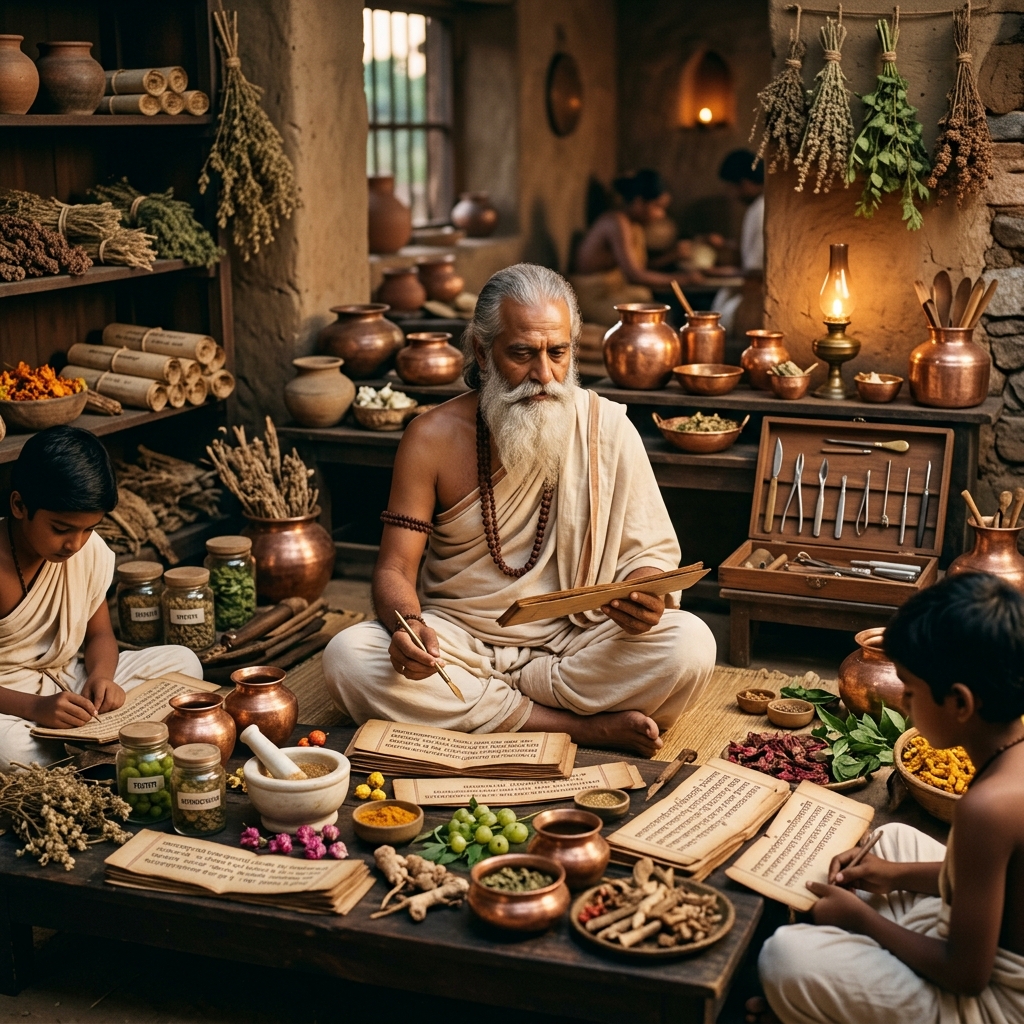
Ayurveda is not merely a system of medicine; it is a comprehensive philosophy of life (Ayus = Life, Veda = Science/Knowledge). Rooted in the Atharvaveda, it evolved from sacred healing incantations into a rigorous empirical science cultivated across major ancient universities like Varanasi, Takshashila, and Nalanda.
Ayurveda is recognized as an Upaveda (subsidiary Veda) of Atharvaveda. It originated from Lord Dhanvantari and ancient Rishis who documented plant chemistry, healing hymns, and elemental energetics long before Western medical texts existed.
Acharya Sushruta compiled the Sushruta Samhita in Kashi (Varanasi). He described 121 surgical instruments (Yantras and Shastras), 300 surgical procedures, cataract surgery, skin grafting, and the world's first documented forehead-flap rhinoplasty.
Acharya Charaka refined the work of Agnivesha to create Charaka Samhita, detailing the Tridosha system (Vata, Pitta, Kapha), metabolism (Agni), tissue nutrition (Dhatus), diagnostic examination (Ashtavidha Pariksha), and preventative immunity (Rasayana).
Acharya Vagbhata synthesized Charaka and Sushruta's works into poetic Sanskrit verses, creating the Ashtanga Hridaya. This became the standard clinical handbook across Asia, Tibet, and Arab trade networks.
Acharya Sushruta's work in Varanasi around 600 BCE transformed surgical practice into a high art form. His descriptions of surgical procedures are startlingly modern.
Using cheek and forehead skin flaps to reconstruct severed noses, laying the foundation for modern plastic surgery.
Using a curved needle (Jabamukhi Salaka) to displace clouded lenses, centuries ahead of European opthalmology.
Crafting 101 blunt and 20 sharp instruments modelled after bird beaks and animal jaws, sterilized over open fire and hot oils.
Submerging human corpses in water for 7 days to decompose tissue, allowing students to peel layers with bamboo scrapers for precise anatomical study.
Ayurveda is purely folk herbalism without surgical or anatomical rigor.
Ancient Ayurveda pioneered complex surgery, anesthesia using Cannabis and wine, bone setting, laparotomy, and meticulous anatomical dissections documented in Sushruta Samhita.
Ayurvedic texts are unscientific religious scriptures.
Charaka and Sushruta applied empirical observation, clinical trials, toxicology, and rigorous cause-effect logic (Karya-Karana Siddhanta) systematic long before the modern scientific method.
Western medicine developed plastic surgery independently of Indian wisdom.
British surgeons in 1793 observed Indian surgeons perform Sushruta's forehead flap rhinoplasty in Pune, publishing it in the Gentleman's Magazine (1794), directly inspiring modern plastic surgery.
Acharya Sushruta is universally recognized as the Father of Surgery. His text, Sushruta Samhita, details over 300 surgical techniques, 120+ surgical instruments, and pioneer plastic surgery procedures.
Charaka Samhita specializes in Kayachikitsa (internal medicine, diagnosis, therapeutics, and dietetics), whereas Sushruta Samhita specializes in Shalya Tantra (surgery, anatomy, plastic reconstruction, and trauma care).
Acharya Sushruta used wine (Madya), Cannabis extracts, and specific herbal narcotics to induce sedation and numbness. He emphasized speed, precision, and post-operative herbal antiseptic dressings.
In ancient India, nasal amputation was a common legal punishment. Sushruta developed a technique using skin flaps from the cheek or forehead, folded over wooden tubes to rebuild nostrils — a procedure still known as the Indian Flap method.
Ayurvedic texts were translated into Arabic in the 8th century (as Kitab-us-Susrud and Kitab-i-Charak), spreading through Baghdad to Islamic Spain and medieval Europe, influencing Avicenna and Galenic medicine.
The Brihat Trayi consists of the three foundational primary treatises of Ayurveda: Charaka Samhita, Sushruta Samhita, and Ashtanga Hridaya by Vagbhata.